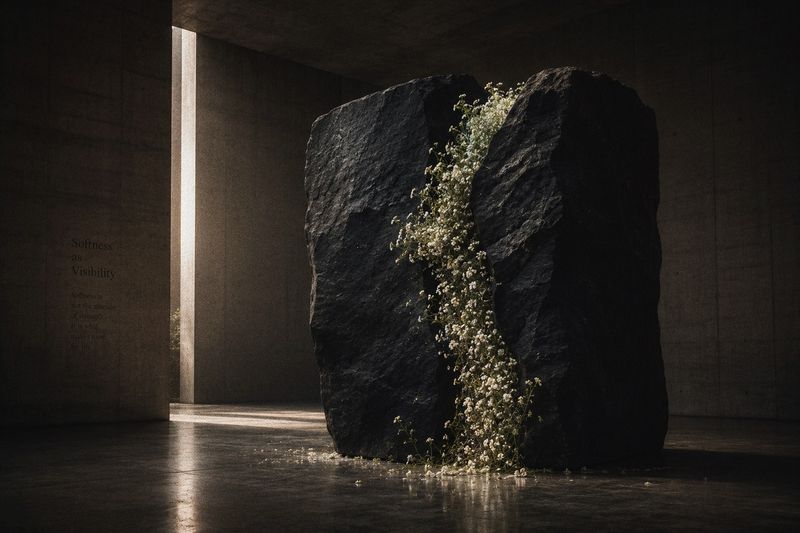
There is a particular kind of visibility that does not arrive loudly.
It does not demand attention. It does not perform strength for survival. It does not sharpen itself into hardness to be taken seriously.
Instead, it arrives quietly. In the slow lowering of shoulders. In the decision to be emotionally present. In the act of allowing oneself to be seen without performance, defense, or spectacle.
For many women, people, and marginalized communities, visibility has often been tied to survival. To be visible has meant to explain yourself, defend yourself, protect yourself, or become legible to systems that were never designed to fully hold you with care.
Softness interrupts that.
Softness becomes a refusal to constantly exist in resistance alone. It becomes a different language of presence. A way of occupying space without needing to harden the body, the voice, or the self in order to deserve recognition.
Within my visual practice, softness is not aesthetic decoration. It is emotional architecture.
I am interested in the quiet moments people return to themselves. The moments where performance falls away and something more intimate appears. The in-between spaces. The pauses after conversation. The stillness before someone speaks. The tension held gently in the body. The emotional textures people carry privately.
These are often the moments that traditional image-making overlooks.
Much of visual culture rewards spectacle. It favors speed, clarity, perfection, and certainty. But the people and communities I am drawn toward often exist within emotional complexity, layered histories, vulnerability, contradiction, tenderness, and survival. Their stories cannot always be captured through loud imagery.
Sometimes visibility looks like stillness. Sometimes it looks like rest. Or solitude. Or quiet eye contact. Or softness that has survived difficult environments without disappearing.
In The Archive of Becoming, portraiture becomes less about performance and more about emotional presence. I think about the body not simply as something to be photographed, but as a container of memory, identity, tension, intimacy, history, and becoming.
This is especially important when thinking about Black women and bodies, which are so often photographed through frameworks of spectacle, pain, consumption, or hyper-visibility. I want to move differently. I want the images to breathe. I want them to hold tenderness without removing complexity.
To me, softness is not weakness. It is the ability to remain emotionally alive in a world that repeatedly asks certain people to disconnect from themselves in order to survive.
And perhaps that is why I continue returning to softness in my work. Because softness creates room for people to exist outside of performance. Outside of expectation. Outside of explanation. It creates room to simply be witnessed.
Not as symbols. Not as statements. Not as representations alone.
But as human beings carrying interior worlds that deserve care, attention, and visibility.